


What is the Primary Key?
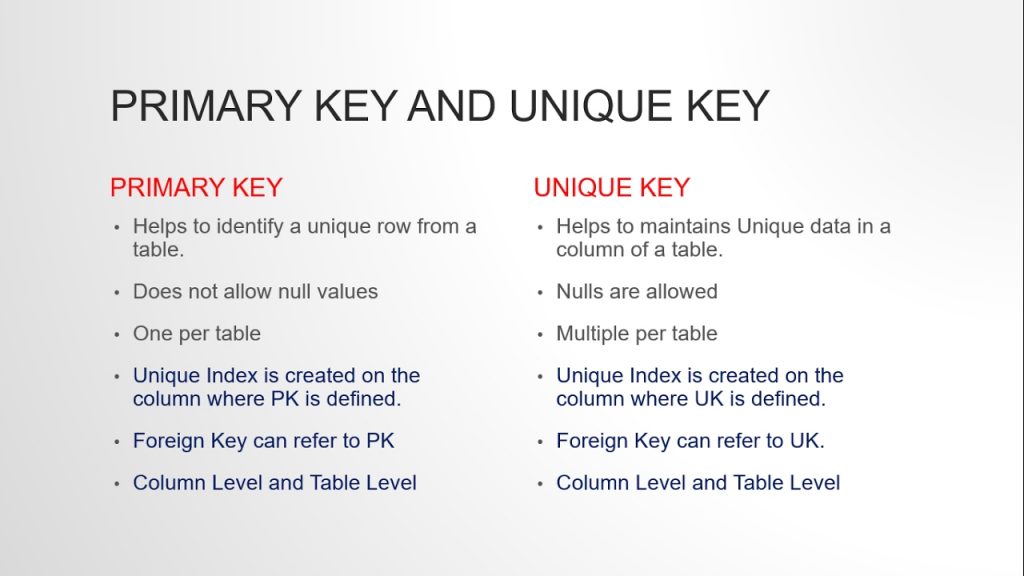
A primary key refers to a column or group of columns in a particular table that exclusively classifies every row in that table. It is impossible to duplicate the Primary key, which means that the same value can’t appear more than once in the table. Every table must have more than one primary key. Difference between primary key and unique key The primary key can restrict at the column or the table level. If someone creates a composite primary key, it should be defined at the table level.
What is a Unique Key?
A unique key refers to a group of one or more than one field or columns of a table that exceptionally recognizes database records. A unique key can perceive as a primary key, but it keeps the power to accept one null value for a table column. It also cannot contain identical values—the foreign key of other tables references unique constraints.


Key differences among primary and unique key
Some of the critical differences which give them individuality are as follows:
- It is possible to have one primary key in a table, whereas there can be multiple unique keys.
- The principal purpose of the primary key is to enforce entity integrity; contrariwise, a unique key determines to enforce unique data only.
- Default index will always be clustered in the primary key, but in the unique key, the default index cannot be clustered.
- The primary key has no power to allow null columns but uniquely allows null columns.
- In the primary key, identical keys are not allowable, while in a unique key, if one or more essential parts are null, it is possible to allow the duplicate keys.
Why use Primary Key?
Some of the essential reasons to use the primary key:
- The main objective of the primary key is to recognize each record in the database table.
- People use the primary key whenever they do not allow someone to enter null values.
- When a person deletes or updates a record, the specified action will undertake to ensure database data integrity.
- The primary key is responsible to Perform restrict operations to delete or update operations for the parent table.
Why use Unique Key?
Some of the essential reasons to use the unique key:
- A unique key determines to make sure that data in the column for each table record is distinctive.
- It is beneficial to allow the user to enter the null value.
- A unique key use because it generates a non-clustered index by default.
- A unique key can use when there is a need to keep null values in one column.
Distinctive Features of Primary Key and unique key
Here are the essential features of the primary key and unique key which gives them individuality:
- The primary key is always about the implementation of the entity integrity of the table.
- It is possible to define more than one unique key in the table as they are non-clustered unique indexes and founds on one or more table columns. However, a unique constraint can effortless reference by a foreign key constraint.
Also read: Difference between recruitment and selection
What is better?
The unique key will always be a better option when you have columns you know shouldn’t contain duplication. On the other hand, the Primary key is ideal when it is impossible to keep null in the table.